Showing posts with label Samuel Adams. Show all posts

Monday, December 14, 2009

A Samuel Adams Problem?

A Fundamental Error
in the "Key Founders" Argument

For those who debate religion and the founding, one of the central topics of conversation centers around the role that the "key founders" had in establishing the American republic. Usually this conversation focuses on five or six "big guns" of the founding era -- Washington, Jefferson, Madison, Franklin, John Adams, and sometimes Alexander Hamilton and Thomas Paine -- whose contributions to the American Revolution, Constitution, etc. are considered to be of greater value or influence than others. And while it is true that the contributions of some founders were greater than others -- who would be silly enough suggest that someone like John Rutledge was as important to the American Revolution as George Washington -- I often find myself being somewhat uncomfortable with the term "key founders." After all, what constitutes someone becoming a "key" founder? What criteria do we use when selecting individuals for this ultra-exclusive classification? For example, could a woman ever be considered a "key" founder? Did not Abigail Adams play a pivotal role in supporting John through the ups and downs of his political career? And what of the many influential and prominent founders who supported revolution but rejected the Constitution? Has their legacy been tainted in some way for being on the "wrong side" of history?

Of course the answer to these questions are complex to say the least. After all, one could easily argue -- without being sexist mind you -- that women had virtually no role in the founding of America. There were no women present at the Continental Congress/Constitutional Convention, nor were women allowed to vote/run for office in the early years of the infant American nation. In addition, one could also logically conclude that those who supported revolution but rejected the Constitution -- Patrick Henry comes to mind -- are of somewhat lesser importance due to the simple fact that their beliefs were overshadowed by those of the "key" founders. Of course this should not suggest that the contributions of women or those who opposed the Constitution are irrelevant, but it does illustrate the fact that some "key" individuals did play a greater role than others.

With that said, I believe that many historians/students of early America/amateur historians/whatever else you wanna call them, are oftentimes quite discriminatory in their selection of "key" founders. It is almost always the case that these "key" founders are men of elite status who embraced the Revolution, accepted the Constitution, and, for the purposes of our blog, were at least ambiguous in their devotion to the Christian religion. For example, Gordon Wood, who the majority of readers on this blog consider to be the finest historian of early America, only mentions seven founders -- Washington, John Adams, Jefferson, Madison, Franklin, Hamilton, Paine, and Burr -- in his book Revolutionary Characters. And while I am sure that Wood himself recognizes the fact that these seven men were far from alone in their endeavors to create a new nation, the fact remains that many important founders are often omitted from the historical dialogue.

Such is the case with Samuel Adams. Despite the fact that he is regularly referred to as the "Father" of the American Revolution -- historian Joseph Ellis calls him the "Lenin of the American Revolution" -- Samuel Adams is almost always omitted from the "Key Founder" classification. In our modern era, Sam Adams has probably become more of a beer symbol than a revolutionary icon. Even this blog is guilty of omitting Sam Adams from our discussions on early America. In our one year run, which has amassed over 600 posts, Sam Adams has only been mentioned IN ONE POST -- and even that post was quite brief of the topic. So how is it that a man who is often considered the father of the American Revolution, adversary of the Stamp Act, organizer of the Sons of Liberty, and all-around champion of the common man be so blatantly ignored?

In his excellent bio of Samuel Adams, author Mark Puls presents a compelling case that the modern historiography of Sam Adams has given most Americans a very skewed and incomplete understanding of the man who Thomas Jefferson referred to as, "truly the man of the Revolution." and "the patriarch of liberty." He writes:
Despite his many achievements and their lasting impact, his legacy goes largely unheralded in recent years, even during a wave of interest about the Founding generation. While Adams was hailed as the "Father of the American Revolution" in his own time, his role in the birth of a nation has been overshadowed by founders who went on to become U.S. Presidents or by men who rose to prominence during the inaugural federal government. Biographers and historians have assigned more significant places to men who had little influence before the Revolution in shaping the birth of the nation or forging its foundational ideals.

[...]

Since Adams' death in 1803, the assessments of his contributions to American history have undergone several revisions, based in part on the views of the Revolution itself. Nineteenth-century historians such as George Bancroft, in his 1882 exhaustive, six-volume "History of the United States from the Discovery of the American Continent" saw Adams as the major figure in American movement leading up to the war: "No one had equal influence over the popular mind." James K. Hosmer's 1888 biography, "Samuel Adams" ranked his subject second only to George Washington in importance to the founding of the United States.

[...]

Until the 1920s, historians treated Adams in the same generally positive light accorded the other Founding Fathers. A revision of his record began with Ralph V. Harlow's 1923 "Samuel Adams -- Promoter of the American Revolution", which portrayed Adams as a propagandist and zealot, a view furthered by John C. Miller's 1936 "Samuel Adams: A Pioneer in Propaganda".

In recent years, Samuel Adams has been treated by historians as a propagandist who stoked the passions of the poor and built resentment against the British to further his own career. Scholars such as Russell Kirk dismissed Adams as a "well-born demagogue" in his 1974 "The Roots of American Order."
Here Puls makes his disgust with the current Sam Adams historiography clear. The idea that the "father" of the American Revolution was a rabble-rousing, doomsday propagandist who preyed upon the ignorance and vulnerability of the poor tends to permeate the current historical interpretation of Sam Adams. Even the recent HBO miniseries, John Adams attempts to portray Samuel Adams as being little more than an ultra-passionate, angry, and vindictive leader of the masses:


Puls continues:

But the historical record and an examination of Adams' writings tell a very different story. Adams and the other colonists involved in the civil rights struggle were not an unthinking mob, but a highly reflective people who stated their case with reasoned arguments in pamphlets, letters, petitions, and newspaper articles. In his writings, Adams placed his faith in a logical persuasion, devoid of feckless emotional appeals, in the same manner of modern newspaper columnists. His readers were highly literate, and well versed in the allusions to ancient Latin and Greek writers and examples from antiquity from which he drew analogies. His crusade eventually drew in intellectuals such as John Adams, Thomas Jefferson, and Benjamin Franklin, as well as affluent men such as George Washington and John Hancock. Mob violence was common in England during the eighteenth century, but these protests never achieved any specific political goals. It's highly unlikely that the successful colonial resistance in the prewar years as well as the Revolution itself and the creation of an independent nation would have occurred without the involvement of the educated and affluent.
If the founders themselves were allowed to select the "key" contributors to the American cause, Samuel Adams may very well be among them. As historian Joseph Ellis states:"In the midst of the current surge of interest in the founders, the most conspicuous absence is that of Samuel Adams, an absence that most of his peers would have found inexplicable."

Or as his second cousin, John Adams stated, "Without the character of Samuel Adams, the true history of the American Revolution can never be written. For fifty years his pen, his tongue, his activity, were constantly exerted for his country without fee or reward."

Perhaps we could make one more slot for dear Sam in our "Key Founders" category?

Sunday, April 19, 2009

Tea Parties: 18th Century v. 21st Century

Comparing the Boston Tea Party to the various tea parties that took place across the nation last week is complex to say the least. After all, we're trying to compare 18th century America with today's society. Most of the social, cultural, and technological norms are completely different now. The majority of American colonists wouldn't even recognize modern America as being their "stomping ground."

With that said, here are a few specific differences between the tea parties of today and the original tea party of 1773:

1. First off, the legacy of the Boston Tea Party (1773) has been used on a number of occasions. In fact, Mahondas Gandhi (not Mahatma Gandhi) invoked the legacy of the Boston Tea Party in 1908 by inspiring his fellow Indians to burn British registration cards. In the early 1970s there were a large number of gatherings that called themselves "tea parties." At one “I Love America” rally led by the Reverend Jerry Falwell, followers were asked to burn bags of tea, symbolizing the people’s anger over the newly-enacted Supreme Court decision, Roe v. Wade. In 1973, the 200th anniversary of the Boston Tea Party, protestors gathered at the White House to call for the impeachment of then President Richard Nixon by throwing bags of tea on the White House lawn. In 1998, two conservative US Congressmen put the federal tax code into a chest marked "tea" and dumped it into the harbor. And finally, in 2006 a breakoff of the Libertarian Party called the “Boston Tea Party” was founded.

2. The motivations behind today’s tea parties and the original tea party of 1773 are completely different. The Boston Tea Party (1773) was actually a protest AGAINST a corporate tax cut, as opposed to today’s tea parties which protested rising taxes and an increase of government spending, etc. In 1773, The British East India Company was nearly bankrupt and instead of providing a "bailout" or government loan, Parliament passed the Tea Act, which eliminated for this company the duty on tea exported to America. As a result, smaller merchants in the colonies were expected to suffer, since they didn’t received the same tax cuts as the East India Company. The Boston Tea Party was the peak of a boycott against a company that got huge corporate tax cuts granted to them by the government. Once the ships from the East India Company arrived in Boston’s harbor, men like Samuel Adams and John Hancock were quick to seize the opportunity and turn it into a political advantage by rallying local Boston merchants to their cause. On December 16, after assembling at the Old South Church to express their grievances, Samuel Adams stood and gave the “secret message” to his devout “Sons of Liberty” (and Masons) to assemble at the docks, where they had their “tea party.” 342 chests of tea (property of the East India Company) were seized and dumped into Boston Harbor.

Now, this is often contrary to what many people know about the Boston Tea Party. After all, most Americans believe that the American Revolution was the result of taxes being levied against them by Britain. This isn’t 100% accurate. To understand the role that taxes played in the American Revolution we must go back to 1765. The British Empire, fresh of its complete rout of the French in the French and Indian War, was faced with a mounting debt as a result of that war. As a result, Parliament decided to levy a small tax (a fraction of one percent) against the colonists in America. Parliament believed that the colonists needed to play off a small portion of Britain’s debt, since the war had been fought to protect the colonists in the first place. As a result, the STAMP ACT was passed. However, the colonists exploded in anger and protested the act. Led by Boston Revolutionary Samuel Adams, the colonists succeeded in having the Stamp Act repealed. One of the main reasons for their success was their usage of the old propaganda phrase, “No taxation without representation,” which had been coined in 1750 by Reverend John Mayhew. By repealing the Stamp Act, the colonists believed they had succeeded and that everything would be ok.

The colonists’ excitement, however, was to be short-lived. In 1766 Parliament passed the often forgotten DECLARATORY ACT, which stated that Parliament had the right and power to govern its colonies, “in all cases whatsoever.” In essence, this became the catalyst for the revolution. It created a “showdown” between the legitimacy of Parliament’s rule and the sovereignty of the colonies. In fact, Thomas Jefferson would quote the Declaratory Act several times in the Declaration of Independence.

So, while taxes were an issue early on, it is important to realize that they played a very limited role in bringing about the American Revolution.

3. The Boston Tea Party was an illegal action of a mob that committed assault, theft, destruction of property, etc. The tea parties of today did no such thing (at least to my knowledge). The Boston Tea Party was literally an act of defiance to the laws of the British. The participants were willfully and knowingly being insubordinate to the will of King and country. The results of their actions caused the British to impose a complete blockade of Boston Harbor. Today’s tea parties, while an expression of anger/intolerance of current government decisions, did not invoke the same response nor did it take the same radical steps of defiance.

4. Today’s tea party participants claim that their petition was a “grass roots” movement led and organized by the people. The Boston Tea Party was not. It was led by prominent and influential Bostonians like Samuel Adams and the VEEEERY rich John Hancock, who, interestingly enough, stood to lose a fortune by the East India Company. His motives were not as pure as we are often taught.

5. The Boston Tea Party was NOT assembled out of a growing concern over the size of government, government spending, etc. Instead it was assembled on issues like colonial sovereignty v. Parliamentary rule, corporate tax breaks, and a lack of government funding for the development of the American merchant class. In fact, this last point (the development of the American merchant class) was a fundamental issue for Thomas Paine in his extremely influential pamphlet, “Common Sense.” It’s worth noting that political activist Glenn Beck has quoted Thomas Paine on several occasions, especially during the tea parties of last week. However, Beck neglects to recognize the fact that Paine was IN FAVOR of bigger government, more government spending, higher taxes, welfare programs, etc.

And while the differences between the tea parties of today and the Boston Tea Party of 1773 are vast, it’s important to remember that at the heart they share the same basic principle: that the people are where sovereignty and power ultimately reside…at least that is the hope of its participants, whether in the 18th or 21st century. And it’s likely that we haven’t seen the end to the legacy of the Boston Tea Party!!!

Thursday, December 20, 2007

The Religion of the Founding Fathers


This posting is inspired by the comments made in the Huckabee posting below. Raven mentioned that he is opposed to the notion that the Founding Fathers were Christian men. Obviously this is a very popular and controversial topic, so I am expecting this post to be a lot of fun. I look forward to what you all have to say.


In his book The Faiths of the Founding Fathers (which I happen to believe is the best source on this issue), author David Holmes has created a religious test of sorts that I feel is very applicable. Holmes states that, "An examination of history cannot capture the inner faith of any man. But in the case of the Founding Fathers of the United States, readers can use these four indicators to locate the founders on the religious spectrum with some confidence." Holmes has devised a four-point test that I believe is very helpful in understanding the religious nature of the Funding Fathers. These four points allow us to put the faiths of the Founding Fathers into perspective. The points are:

1. Church Attendance
2. Approach to the Sacraments and Ordinances
3. Level of Church Activity and Involvement
4. The Type of Religious Language Used

Using these four criteria, Holmes states where each of the Founding Fathers ranks on the religious spectrum. First off, it is important that we recognize the role that the Enlightenment and the Great Awakening played in shaping the religious beliefs of colonial America. As Daniel Walker Howe states in his epic book What Hath God Wrought, religious ideology, especially Christian ideology, was very different during the colonial era than it is today. By looking at these four points, we can determine to what degree deism and Christianity influenced the individual.

There is of course many other factors than these simple four points, which shaped the individual beliefs of our Founding Fathers. These points, however, can help us see the impact of deism and Christianity on the individual. A deist would be more likely to attend church less frequently, would strongly oppose sacraments and ordinances, would have a low level of church involvement, and would use very neutral religious language when referring to deity. An orthodox Christian, however, would be the exact opposite. With that said, let us look at several of the Founding Fathers using the test provided by Holmes.

George Washington: Obviously Washington is the most popular of the Founding Fathers, and there is a great deal of religious myth that surrounds him. There is perhaps more written on the religious views of Washington than any other Founding Father. His legacy has been used by secularists and religious zealots alike, in order to shape their respective agendas. But what were his religious beliefs? Here is what Holmes states:


1.) Church Attendance: Washington, though not as devout as the typical orthodox of his day, did attend church with some regularity, and as Holmes states, “held organized religion in high regard, and was known to pray privately.”

2.) Approach to the Sacraments and Ordinances: Washington was known for regularly leaving church services before any and all sacraments. Washington strictly refused to partake in any other religious ordinances.

3.) Level of Church Activity and Involvement: Washington was a vestryman in both the Anglican and Episcopal churches, but was never confirmed in any church. Washington strongly opposed any orthodox allegiance to any one church, and remained a non-ordained, non-confirmed churchgoer.

4.) Religious Language Used: Washington’s religious vernacular was mixed with Deist and Christian phrases. Though he regularly referred to deity as “Providence” and “the Grand Architect” Washington also used the words “God” and “Christ” on a regular basis as well.

So where does Holmes rank Washington? He calls him a “Christian Deist.”

Thomas Jefferson

This one is almost too easy. Jefferson attended very little church, he never participated in sacraments and ordinances, was never ordained or confirmed (in fact he believed such practices were morally reprehensible), and his religious language was VERY common for a Deist (just look at the Declaration of Independence where Jefferson uses phrases like "Providence" and "Nature's God"). Jefferson also regularly denied the divinity of Christ, but referred to him as "the greatest philosopher." In his Bible, Jefferson even removed all references to Jesus being a savior figure.

Holmes states, and I strongly agree, that Jefferson was a non-Christian Deist. This one is pretty easy.

Benjamin Franklin
Franklin is an interesting figure. He donated a large amount of money to virtually every religion in Philadelphia and even attended most of them. Franklin, however, was never confirmed, nor did he participate in sacraments and ordinances of any church. Franklin even states in his autobiography that he denies the divinity of Jesus. Holmes also calls Franklin a Deist.

So where are the Orthodox Christians? Here is just a small list:
Patrick Henry
Samuel Adams
John Jay
Martha Washington
Charles Carrol
Elias Boudinot
John Q. Adams

And Christian Deists? Here again is another small list that Holmes mentions:
George Washington
Abigail Adams
Alexander Hamilton
John Hancock

And here is Holmes's list of non-Christian Deists:
Thomas Jefferson
James Madison
James Monroe
John Adams
Benjamin Franklin
Thomas Paine

Ok, let the debating begin!

Monday, December 10, 2007

Boston Massacre: Brilliant Propoganda or the Genuine Article


Of the many events prior to war with Britain, the Boston Massacre is one that receives a lot of attention. Yet this "massacre" only claimed the lives of five citizens (interestingly enough, a recently freed slave of Native American and African American decent, a man named Crispus Attucks, has been labeled as the first casualty of the American Revolution for being the first to die at the Boston "Massacre").

The painting above was done by one Paul Revere (I'm sure we all recognize that name) at the request of Samuel Adams. Revere's origional work was actually done as an engraving, not a painting.

The "Massacre" created such a stir in Boston that many citizens demanded that the soldiers responsible be shot at the same location of the citizens. What is interesting about the Boston Massacre is the fact that John Adams came to the defense of the soldiers. He stated that defending the soldiers in court was one of the noblest things he ever did in his life.

So my question is this: was the Boston "Massacre" a genuine slaughter or was it politically spun into one of the best pieces of revolutionary propaganda? As for me, I side with Propaganda!

Sunday, October 28, 2007

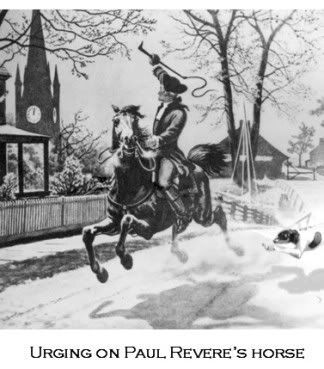
The Legend of Paul Revere


"Listen my children and you shall hear
Of the midnight ride of Paul Revere."

These opening lines to Henry Longfellow's epic poem "Paul Revere's Ride" have been recited in classrooms across this country. In fact, most people only know of Paul Revere thanks to Longfellow’s 1860 poem (almost 100 years after the actual event). Within the historical community, Reveres infamous ride has been scrutinized for its embellished nature. As we know, much of Paul Revere's "ride" was quite different from Longfellow's dramatic portrayal.

First off, we can all rest assured that Paul Revere never shouted, "the British are coming." To have done so would have destroyed the secrecy that was needed for the mission. We can also be certain that Paul Revere was not alone on April 18, 1775. After receiving his initial instructions from Dr. Joseph Warren to warn John Hancock and Samuel Adams of the impending doom, perhaps as many as fifty other riders were caught up in the excitement of the moment and set out to warn the countryside.

While riding across the Boston countryside, Revere was actually detained by the British, had his horse confiscated, and was forced to march back to town at gunpoint. In fact, Revere was never able to reach Adams and Hancock. Fortunately, both men were warned by other riders of the danger that was approaching, as was the militia, which prepared for the infamous Battle of Lexington and Concord.

To be certain, Revere was an important figure inside Boston's revolutionary underground. He had been entrusted by important and influential men to carry out various assignments (one of them being the stained glass portrayal of the "Boston Massacre") and was a honored member of several organizations of influence (the Masonic Lodge in Boston being the most important). Though his infamous ride may be entwined with legend and folklore, Paul Revere's involvement in the early years of Boston's revolutionary fervor are both influential and worthy of further study.

Wednesday, October 24, 2007

Founding Fathers in the 21st Century

All of us have heard the polular cliche: "What would our Founding Fathers do or think if they could see us today?" As nostalgic as this statement may be, it also carries a lot of weight simply because we revere our founders as "holy." They mean so much to us because we are their political offspring. We long for their legacy because it helps us define who we are as "Americans" and "patriots."

Even today, the legacy of the Founding Fathers is deeply rooted in the modern American culture. George Washington's image is still found on the dollar and quarter, Benjamin Franklin on the $100 bill, Amexander Hamilton of the $10. Samuel Adams is the name of a popular alcoholic beverage (which I happen to be quite fond of). It is impossible to go anywhere in our nation without seeing their legacy. In fact, I live on Jefferson Avenue!!!

My question is this: can anyone think of any other nation or people where its founders mean so much? While it is true that England, France, Spain, Russia, China, etc have longer and richer histories than does the United States, none of those nations revere their founders as much as we do. This may be due to the fact that our founders are relatively modern in world history. One would have to go a long way back to uncover the history of England or France's founders, and even then, the nations of Europe have so many different eras where a "founding" occurred.

In America this is not the case. We know exactly when our nation's founding took place. Though we may argue specifics, nobody can argue the overall theme 0f when and how our nation was founded. It is for this very reason that our Founding Fathers have become so endeared and important to us. They are special not only for leading the most important and successful revolution in world history, but also because they are so near to us. They are so very accessable. A stoll down Washington D.C. or Boston is sufficient evidence of this fact.