Showing posts with label Seven Years' War. Show all posts

Thursday, July 3, 2008

Catholic/Protestant Wars in the Old and New Worlds

The traditional view of early colonial historiography has divided the various wars between England and France -- in both the New and Old Worlds -- into separate conflicts that are seemingly unrelated to one another. Instead of seeing these various wars as being linked with one another, many historians have chosen to classify these various Franco-English wars as unique and individual conflicts. For example, from the latter part of the 17th century to the middle of the 18th, historians have traditionally taken note of four SEPARATE conflicts between the French and the English: King William's War, Queen Anne's War, King George's War and the French and Indian War -- as they were known in the colonies. However, what is often an overlooked fact of these conflicts is the reality that they all shared the same underlying root cause: religious intolerance.

Here is a list of the major Franco-English conflicts during the late 17th and 18th centuries:

Date: In Europe: In America:
1688-1697
In Europe: War of the League of Augsburg
In America: King William's War

1701-1713
In Europe: War of Spanish Succession
In America: Queen Anne's War

1740-1748
In Europe: War of Austrian Succession
In America: King George's War

1756-1763
In Europe: Seven Years' War
In America: The French and Indian War

***Chart taken from A Religious History of the American People by Sydney Ahlstrom, 58.***

From this chart, it is evident that a repeating cycle of violence and intolerance between England and France -- in both the New and Old Worlds -- was keeping these two rival nations in a constant state of war with one another. But what was main cause for such violence? What main factor continued to bring these two neighbors into conflict with one another?

Regardless of the smaller instigating factors of each of these wars, there remained a steady stream of religious fervor, which proved to be the main catalyst for war in each occasion. As colonial historian Karen Kupperman points out:
We should not underestimate the emotional force of this confrontation between Christians, which has been compared to the Cold War of the twentieth century. Each side believed the other was absolved by its religion of all normal moral and ethical behavior in dealing with the enemy, and capable of the most heinous plots.(From Roanoke: The Abandoned Colony, 4)
For the English, there was nothing worse than facing the possibility of a New World being ruled by the Pope.

On the French side, religious passions were every bit as hot as their English foes. Sydney Ahlstrom has pointed out in his book A Religious History of the American People:

"During the century in which France's colonial aspirations awakened, there also occurred a remarkable resurgence of Catholic piety...In New France the faith and institutions of the Roman church gained a centrality and importance that was equaled in no other empire, not even New Spain." (59-61).
Faced with such religious enthusiasm on the part of the English and the French, it comes as no surprise that this "holy war" would go unresolved for almost a century.

By choosing to look at these various conflicts through the lens of religious enthusiasm, we can clearly see that these wars were not separate quarrels but were, in fact, linked through a chain of religious intolerance. English Protestants, still burning with the fires of the Reformation, saw the New World as an additional arena where Catholic supremacy threatened to destroy God's TRUE work. French Catholics, inspired by the resurgence of Catholic piety, sought to spread the Pope's dominion across the seas and choke out the rebellion of the Protestant heretics.

Wednesday, April 16, 2008

Flags of the Revolution

If you've been watching HBO's hit miniseries, John Adams, chances are you have noticed the assortment of flags during its opening credits. One of the neat things about the American Revolution is the fact that the colonists created and flew a number of banners, which are now used to commemorate specific events in this all-important era of American history. Unfortunately, the majority of these flags are unknown to the American public today. It's a shame because these flags provide an interesting insight into the history of the American Revolution, which is why I think they are worthy of recognition. With this in mind, here are a handful of America's earliest flags:

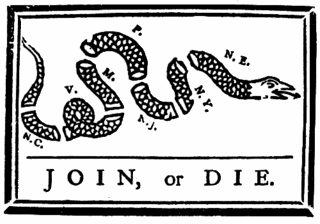
The first flag portrayed in the opening credits is the "Join or Die" banner. This flag, which has its origins in the French and Indian War and not the American Revolution, was actually derived from none other than Benjamin Franklin. Franklin designed the flag to suggest that unity between the British colonies was essential in securing a British victory over the French. For obvious reasons, the banner was brought back during the American Revolution. Here is a link to a previous posting on Franklin's "Join or Die" slogan.

Another flag that has received a lot of attention is the "Appeal to Heaven" flag. This flag's origin is also before the American Revolution. Settlers in Massachusetts used the green tree as a symbol of peace roughly 100 years before the American Revolution. When war broke out, the flag was naturally adopted as a rallying banner for their cause. General George Washington even adopted the flag and used it as the official banner for his navy (a navy he funded himself). Here is a link to an older posting on this flag.

The British Ensign was the official banner of the British Navy, and was flown at every major seaport within the empire. Many historians speculate that this flag's design was the inspiration for the design of the current United States flag.

The "Sons of Liberty" flag as it was commonly called by the Americans was created in 1765 during the protests over the Stamp Act. The flag's nine stripes represent the nine colonies that stood in defiance to Great Britain. Interestingly enough, the flag became known in Great Britain as, "The Rebellious Stripes." Naturally, the flag had to be retired and replaced once the remaining four colonies joined in open rebellion to Britain. In the John Adams miniseries, this flag can be seen in various scenes that include Sam Adams and the Sons of Liberty.

The yellow "Don't Tread on Me" flag (officially known as the Gadsden Flag) is arguably the most famous and popular flag of the American Revolution. This flag was presented to the Continental Congress by South Carolinian Christopher Gadsden. The flag was used for a time by the Continental Navy, but was later replaced. The interesting thing about the Gadsden Flag is that it provides us with an insight into the popularity of the rattlesnake in colonial America. During this era, many Americans embraced the myth that a rattlesnake, if chopped into pieces, would come back to life if the snake were buried before sundown. This is why Benjamin Franklin's "Join or Die" snake was so popular. The idea of national unity when combined with snake folklore was a powerful symbol. In fact, the rattlesnake was so popular that it was seriously considered for the national emblem. Benjamin Franklin became its most ardent proponent, claiming that the rattlesnake would make the perfect symbol of the new American republic. Te reasons for embracing the rattlesnake as the national emblem were:

*The rattlesnake has no eyelids and is therefore eternally vigilant.
*Colonial Americans believed that the rattlesnake would never attack first, and that it never retreated from a fight.
*Colonial American society believed that a rattlesnake never slept, suggesting that the animal never tired.
*The rattlesnake is indigenous to North America


Benjamin Franklin was so passionate about making the rattlesnake the national emblem that he adorned his home with the Gadsden Flag. When the eagle was finally accepted as the new national emblem, Franklin protested by proclaiming the eagle, "a despicable vulture of the sky."

The "Grand Union Flag," which is often considered by historians to be the first "official" American flag, was used between 1775 and 1777. The flag was an adaptation of the British Naval flag, which was altered by the inclusion of the thirteen alternating red and white stripes (which represented the thirteen colonies). The flag kept the original red cross of St. George and white cross of St. Andrew, which represented American devotion to Great Britain. It is important to remember that in 1775 the majority of American colonists were still opposed to a complete break with Britain. This flag symbolizes their hope for reconciliation and loyalty to the motherland.

This was the personal flag of General George Washington during the American Revolution. As strange as it may sound today, generals carried flags into battle for identification. This allowed couriers and other staff to be able to locate the general on the battlefield. This flag always accompanied George Washington and his "life guard" (a select group of men that served as Washington's security detail). This flag can be seen in HBO's John Adams series when the General makes a stop at the home of Abigail Adams and during the siege of Boston from Dorchester Heights.

As the British commenced their attack up Breed's Hill on the morning of June 17, 1775, this flag could be seen flying from the top of nearby Bunker Hill. This flag would forever commemorate that encounter and give Bunker Hill the distinction over Breed's Hill (where the fighting actually took place).

This flag, which is known as the American Naval Jack, was flown on several American naval ships during the American Revolution. The current United States Navy is still using this flag. In fact, it is tradition that the ship with the longest total period of active service be given the distinction of flying this flag. Currently the U.S.S. Kitty Hawk carries this distinction. It is also worth noting that the Secretary of the Navy ordered all Navy vessels to fly this Navy Jack for the duration of the war on terrorism. Here is an interesting link for more information on the Navy Jack.

This flag, which is often referred to as the "Vermont Flag" or the "Green Mountain" flag was first flown by Ethan Allen during his raid of Fort Ticonderoga. The flag was later adopted as the official flag of the Republic of Vermont, since Vermont did not join the union until 1791.

Of course we cannot forget the legendary "Betsy Ross" flag. Though its origins are a source of intense historical debate (click here for more on the Betsy Ross flag), the banner has remained a traditional emblem of the American Revolution. The "Betsy Ross" flag was used by the army, while the flag to the right was the most widely accepted and distributed flag of the infant United States during the yearly years of the republic


Some other interesting flags of early American history:
The earliest known Viking flag, which depicts a raven. Ravens were important birds for the earliest seafaring voyages, since they naturally flew in the direction of land. It is thought that the Vikings under Leif Ericson could have flown this flag during their voyages around the American coast.

This was the flag carried by Christopher Columbus to the "New World." The flag represents the rule of King Ferdinand and Isabel (in Spanish spelled Ysabel). Upon his arrival, Columbus is said to have posted this flag as an act of claiming the lands for the Spanish crown.

This flag represented England as far back as the Crusades. It also accompanied John Cabot during his exploration of the American coast, and was carried by the Pilgrims on the Mayflower in 1620.

You could make the argument that this is the first flag of New York. Known as the Dutch East India Flag, this banner flew proudly over the Dutch fortresses of New Amsterdam (the "A" in the flag represents Amsterdam, the motherland's capital). It would take several years before the city of New Amsterdam would fall to the British and be renamed New York.

Wednesday, March 26, 2008

Washington Orders Inoculation

One of the most stirring scenes in HBO's new miniseries John Adams is the inoculation of Abigail and her children. Instead of today's modern inoculation methods (which still cause many to squirm and even pass out), colonial inoculation was much more barbaric. The process involved the cutting of the flesh accompanied by the introduction of the smallpox virus. As can be imagined, many within the colonial community saw inoculation as an insane method of treatment. There were even debates amongst medical practitioners as to its effectiveness.

What most people don't know when it comes to inoculation during this time period is that General George Washington actually ordered the soldiers of the Continental Army to be inoculated. Washington was a strong supporter of inoculation, believing that the medical procedure would greatly reduce the chances of infection. Though the procedure had many skeptics, Washington firmly believed that the benefits of inoculation far outweighed the risks. In fact, Washington became so paranoid about the spread of smallpox during the early years of the war that he literally became obsessed with inoculating the troops. During the seige of Boston, Washington's concern about the spread of smallpox caused him to issue an order stating that no soldier could enter the city unless he had been infected with smallpox in the past.

Washington's experience with smallpox during his youth was probably the primary determining factor in shaping his opinion on inoculation. During a trip to the Caribbean, Washington was infected with smallpox. In fact, Washington carried a few pockmark scars on his face to remind him of this nearly fatal encounter. His experiences during the French & Indian War had also confirmed to Washington that inoculation was essential for any army. During the war, Washington witnessed several British raids that were unsuccessful, due to the depleted manpower of the British Army.

In his highly acclaimed biography His Excellency, historian Joseph Ellis makes the claim that Washington's decision to inoculate the Continental Army was one of his finest moments:

Washington understood the ravaging implications of a smallpox epidemic within the congested conditions of the encampment, and he regularly quarantined patients that were infected with the virus...And although many educated Americans opposed inoculation, believing that it actually spread the disease, Washington strongly supported it...When historians debate Washington's most consequential decisions as commander in chief, they are almost always arguing about specific battles. A compelling case can be made that his swift response to the smallpox epidemic and to a policy of inoculation was the most important strategic decision of his military career.
In today's modern world we enjoy the benefits of understanding the scientific advancements of modern medicine. In today's world the decision to be inoculated is a "no-brainer" of sorts because of our understanding of infectious diseases. For colonial Americans, however, this was very much a roll of the dice. Fortunately for the Continental Army, Washington was brave enough to take the gamble.

Friday, December 14, 2007

Documentary of the French & Indian War

We often forget just how important the French & Indian War (7 Years War) really was in shaping the American colonies. So many of the struggles of the French & Indian War paved the way for the American Revolution. In a way, the French & Indian War laid the groundwork for the future to revolution to come. PBS recently did a documentary on the French & Indian War. Here is a video about it:

Monday, October 29, 2007

Influence of Franklin's "Join or Die"


In early 1754, Philadelphia printer Benjamin Franklin became one of the earliest political cartoonists in American history. As a printer, Franklin had regularly published political commentaries on various issues. His "Join or Die" publication, however, was quite different and would be remembered for generations to come.

During the early part of 1754, Franklin became quite concerned about the security and future of the British colonies. He believed that each individual colony was going too far in its own direction, and thus neglecting the need for unity. As a result, Franklin created this early political cartoon that served as a call for unity. The cartoon (originally done as a wood carving) was posted not only in Franklin's paper, but was distributed across the colonies. The snake (each section representing an individual British colony), was purposely cut into pieces, suggesting that death would come not only to the snake, but to the colonies as well if they chose to stay divided. (It is also worth noting that 18th century society believed that a snake would come back to life if the pieces were all put together and buried before sundown).

During the French and Indian War, Franklin's "Join or Die" slogan was used as a battle cry, inspiring colonies to unite against the French. In the years prior to the American Revolution, Franklin would again use his "Join or Die" logo to promote union with the British (Franklin even suggested to Parliament that the colonies could be joined with Great Britain in the original Acts of Union, which had united Scotland and England). England's passage of the Stamp Act in 1765 gave Americans a cause to rally around. Naturally, Franklin's slogan was brought out of the closet, this time to rally against the British.

With the onset of the American Revolution, patriots from across the colonies used Franklin's "Join or Die" to promote the cause of independence. The slogan could regularly be seen in the windows of shops, on flags, and in newspapers.

Years later, Northerners would again resurrect Franklin's political cartoon to promote the cause of unity in the early years of the Civil War. There are even more recent instances of "Join or Die" being used to promote a political cause. During the 2000 presidential election, Republicans raised the banner of "Join or Die" to promote unity in the party. I guess this is proof that political cartoons may evolve, but the "classics" never die. I'm sure we have not seen the end of Benjamin Franklin's "Join or Die" slogan.